

August 1, 2025
- By : Ambassador Team
At The Ambassador, we work closely with families who are navigating aging, caregiving, and end-of-life transitions. One thing we see far too often is how stressful and expensive things become when estate plans are unclear or out of date.
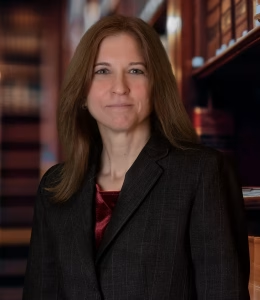
That’s why we spoke with Bridget Eichinger, Esq., a Westchester and Rockland-based attorney who practices exclusively in the areas of estate planning, estate administration and elder law. Her solo practice is focused on helping individuals and families make thoughtful, protective plans for the future. The conversation was full of reminders — not just about documents, but about peace of mind.
Whether you’ve never created a will or just haven’t updated anything in awhile, here are some essential insights to help you protect your loved ones and your legacy.
Three Documents Every Adult Should Have
If you do nothing else, start with these:
- Durable Power of Attorney — Gives someone the authority to access your accounts and handle your financial matters during your lifetime, which becomes imperative if you’re ever unable to do so.
- Healthcare Proxy — Names a trusted person to make medical decisions on your behalf if you can’t speak for yourself.
- Last Will and Testament — Ensures your assets are distributed according to your wishes by the people you trust most, and names guardians for your minor children.
These documents form the foundation of a plan and can be just as important for young adults as they are for older individuals, because unfortunately any of us can become incapacitated or pass away.
Understanding Probate vs. Non-Probate Assets
Not all assets pass through your will. In fact, many of them don’t.
- Probate assets (like a bank account in your name only or a home titled just to you) require court authorization for your Executor to transfer them after your death.
- Non-probate assets (like assets held by a trust, retirement accounts with a named beneficiary or jointly owned property with survivorship rights) pass without court involvement.
Understanding the difference — and structuring your assets accordingly — can reduce delays, costs, and conflict for your family.
Don’t Let Your Trust Stay Empty
Once a trust is established, ensure you actually “use” it. A trust only controls the assets you retitle to it. That means transferring ownership — like changing a deed or updating account registrations — so that the trust, not you personally, holds them.
Think of a trust as a container. Creating it is just step one. Funding it is what gives it power.
Trusts can help:
- Avoid probate
- Manage money for minors or individuals with disabilities
- Keep assets in the family line and protect them from your beneficiaries’ creditors
- Protect assets from long-term care costs
- Minimize estate taxes
The type of trust you need (trusts can be revocable or irrevocable, can be created now or designed to come into being only upon your death, and can be structured so that income taxes on what they earn is still paid by you or by the trust itself) depends on your goals and how much control you’re willing to give up. That’s where working with an estate attorney becomes essential.
Why Beneficiary Designations Matter So Much
It’s not enough to write a will — your retirement accounts, life insurance, and some investment accounts pass according to the beneficiary designations you’ve filed with each institution.
If those are out of date, they won’t be consistent with your wishes, and the designation that you have filed with each institution will control the specific asset, not what is written in your updated will. Many people forget to update their beneficiary designations after major life events like divorce, remarriage, or the death of a loved one.
Coordinating your beneficiary forms with your overall plan is a critical and often overlooked step.
2025 Estate Tax Rules: Big Changes You Should Know
Estate tax thresholds have shifted — and understanding them now could help your family avoid unnecessary taxes later.
- Federal estate tax exemption is $13.99 million per person in 2025.
- Due to the One Big Beautiful Bill Act, signed into law on July 4, 2025, this exemption will increase to $15 million in 2026 instead of dropping down at the end of 2025 as previously scheduled.
- New York’s estate tax exemption is $7.16 million per person in 2025.
- Federal gift tax annual exclusion of $19,000 per person per year, allowing you to make gifts of that amount or less to loved ones without filing a gift tax return.
- Important: If your estate exceeds $7.518 million, you trigger New York’s “cliff” rule, and your entire estate becomes taxable, not just the amount over the exemption.
- Top NY estate tax rate for 2025: 16% for estates over $10.1 million.
- Top Federal estate tax rate for 2025: 40% for estates over $14.99 million.
Even if your estate doesn’t seem large, the value of life insurance, real estate, business interests and retirement accounts can add up quickly. That’s why working with an estate attorney is so important. The right strategy — including how you title your assets, set up trusts, and make use of gifting — can help you stay below key thresholds.
Why You Need to Keep Your Plan Updated
It’s not just your life circumstances that change — laws do, too. For example:
- The SECURE Act (2020) changed the rules around inherited retirement accounts.
- New York’s estate tax “cliff” rule created a significant impact for moderately high-value estates.
- The 2025 federal exemption update dramatically altered what families expected for 2026 and beyond.
- The 2025 One Big Beautiful Bill Act changed income tax rules so that investors making more than $500,000 in income annually could reap significant benefits from breaking up assets into separate irrevocable trusts.
- The June 2021 changes to New York’s Power of Attorney law.
An estate plan isn’t “set it and forget it.” It’s a living strategy. Revisit your documents with your attorney at least every five years — and anytime you experience a major life change like marriage, divorce, the birth of a child, or the death of a loved one.
Final Thought
Estate planning is one of the most protective, empowering things you can do for the people you love. It brings clarity in moments of confusion, direction in times of grief, and ensures that your values and intentions are honored — now and in the future.
You can read more about estate planning generally on Bridget Eichinger’s website: bteplan.com. If you’d like to speak with someone who can walk you through what’s needed and help create a plan tailored to your family and life, we encourage you to reach out directly to an attorney who practices in the area of estate planning and elder law about your specific needs.
This article is for general informational purposes only and does not constitute legal advice or create an attorney-client relationship. Every individual’s situation is unique, and we encourage you to consult with a qualified estate planning attorney for guidance specific to your needs. Any resources or links shared are for educational use and do not imply endorsement of any specific service or provider.